Skip to content
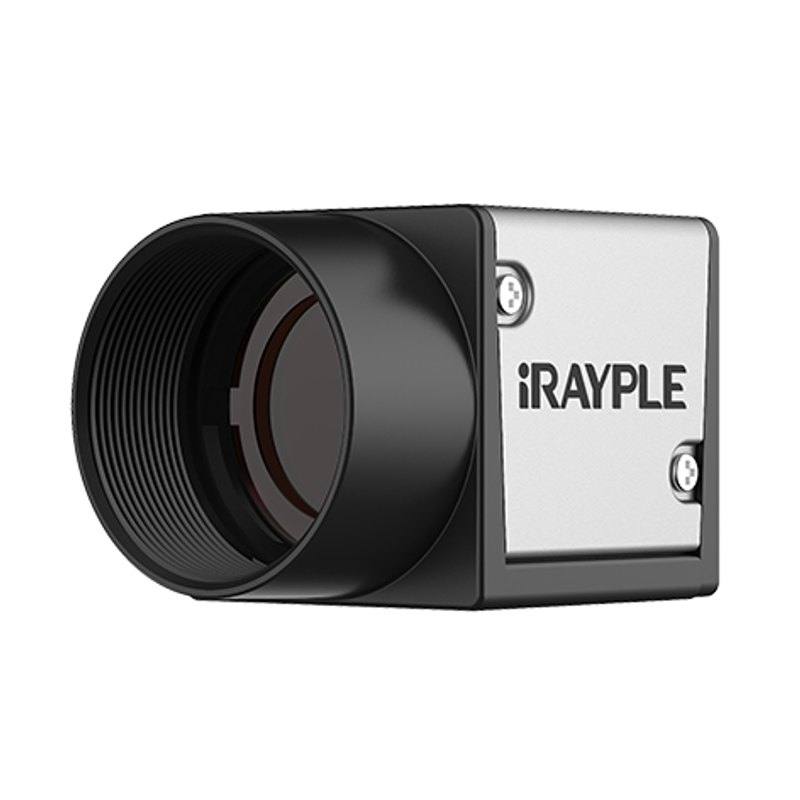
iRAYPLE A7500CU75E (2448x2048, 75fps, IMX250, USB3.0) machine vision camera
  • Rosepetal compatible
  • Recommended by AIS Vision

iRAYPLE A7500CU75E

A7500CU75E

The iRAYPLE A7500CU75E is a high-speed 5-megapixel color USB3 Vision camera built around the Sony IMX250 Pregius global shutter CMOS sensor at 2/3" format with 3.45 µm pixels. It achieves up to 75 fps at full 2448x2048 resolution and outputs BayerRG/BayerGB 8/10/10Packed pixel formats. The camera complies with USB3 Vision and GenICam standards, features optical-isolated I/O via a 6-pin Hirose connector, and can be powered from the USB bus or an external 9–24V DC supply. Its 29x29x29mm aluminum housing weighs 60g and operates across -30°C to +50°C, making it well-suited for high-throughput machine vision inspection tasks.

Brand
iRAYPLE
Camera type
Area Scan
Interface
USB 3.0
Resolution
5 MP
Horizontal resolution
2448 × 2048 px
Mono / color
Color
Sensor manufacturer
Sony Pregius
Sensor model
Sony IMX250
Shutter
Global Shutter
FPS
75 fps
Mount
C-Mount
Sensor size
2/3"

Technical overview

The iRAYPLE A7500CU75E is built around the Sony IMX250 Pregius global shutter CMOS sensor in 2/3" format, producing a 2448x2048 pixel array at a 3.45 µm pixel pitch for a native 5 megapixels. The global shutter architecture eliminates the rolling-shutter distortion that plagues fast-moving parts on conveyors — every pixel is exposed simultaneously — making it a reliable choice wherever parts or web materials travel at speed. At full resolution the camera sustains 75 fps over USB 3.0, which translates to roughly 75 complete 5 MP frames per second available for downstream processing. Bayer-pattern output in BayerRG or BayerGB mosaic at 8-bit or 10-bit (including 10-bit packed) gives integrators flexibility in balancing per-frame data volume against bit depth for scenes with reflective labels, shiny metal, or mixed illumination.

The USB 3.0 interface complies fully with the USB3 Vision and GenICam standards, so the camera drops into any compliant SDK — including Halcon, VisionPro, and NI Vision — without proprietary drivers. Power can be drawn directly from the USB bus, eliminating a separate power supply in simple setups, or supplied externally at 9–24 V DC through the 6-pin Hirose connector that also carries optically isolated I/O lines for hardware trigger and strobe output. The optical isolation protects the camera from ground-loop noise on factory-floor wiring, a practical detail that matters when the camera shares a panel with VFDs or solenoids. The C-Mount lens interface covers the 2/3" optical format, giving access to a wide catalogue of standard machine-vision lenses — fixed focal length, telecentric, and line-scan — without adapters.

The 29x29x29 mm aluminium cube body weighs only 60 g and consumes 4.2 W, making it straightforward to mount in tight fixtures, robot end-effectors, or multi-camera arrays without significant mass or thermal load. The -30 °C to +50 °C operating range accommodates refrigerated food-inspection tunnels, outdoor automotive final-of-line stations, and semiconductor fab clean rooms alike. Together, the combination of Sony Pregius image quality, 75 fps throughput, global shutter, compact form, and standards-compliant USB3 Vision interface positions this camera at the intersection of high-throughput inspection and cost-sensitive deployments where GigE or CoaXPress licensing fees would be disproportionate.

Best for

  • High-speed surface and cosmetic defect inspection on fast-moving conveyor lines — 75 fps at full 5 MP resolution means a 100 mm/s conveyor yields roughly 1.3 mm of part travel per frame, keeping motion blur tightly bounded for each captured image.
  • Packaging print verification and label OCR/OCV where color fidelity matters: the Bayer-pattern Sony IMX250 resolves fine print detail at 5 MP while retaining the hue information needed to distinguish label variants or detect wrong-colour caps.
  • Dimensional gauging and presence/absence checks on electronics PCBs, connector housings, or semiconductor substrates, where the global shutter prevents geometric distortion on parts fed by pick-and-place or indexing mechanisms.
  • Robot-guided pick-and-place or bin-picking applications that demand a lightweight camera body — at 60 g and 29x29x29 mm the A7500CU75E can be mounted directly on a collaborative-robot wrist without exceeding payload margins.
  • Multi-camera inspection arrays for wide-format objects — the USB 3.0 bus power and compact body let integrators deploy multiple cameras from a single host card without external power distribution, simplifying cabinet wiring.

Selection notes

  • Lens selection must cover the 2/3" sensor format. A lens specified only for 1/2" or smaller will vignette the corners at full 2448x2048 resolution. Confirm the lens image circle at the working f-stop, not only at full aperture.
  • USB 3.0 cable length is limited to roughly 3–5 m with standard passive cables. For longer runs to a cabinet-mounted PC, use an active USB 3.0 optical cable or a USB 3.0 repeater; do not exceed the USB power-delivery spec or the camera will need to be switched to the external Hirose power supply.
  • The 10-bit pixel format increases per-frame payload by 25 % compared to 8-bit. At 75 fps this raises demands on host CPU, PCIe bandwidth, and storage throughput; verify the full data path before committing to 10-bit at maximum frame rate in continuous acquisition.
  • Triggering via the 6-pin Hirose opto-isolated I/O is the correct approach for synchronising with PLCs or encoder-based conveyor triggers. Do not rely on software trigger for motion-synchronised inspection — latency jitter will produce inconsistent field-of-view positioning on the part.
  • The camera outputs Bayer-pattern (BayerRG / BayerGB) raw colour data; debayering to RGB must happen in the host SDK or application. For applications that only need luminance — presence/absence, barcode, or monochrome gauging — evaluate whether a monochrome-sensor alternative would deliver higher effective sensitivity and sharper MTF by avoiding the colour filter array penalty.

Specifications: General
BrandiRAYPLE
Camera typeArea Scan

Specifications: Sensor
Resolution5 MP
Horizontal resolution2448 × 2048 px
Mono / colorColor
Sensor manufacturerSony Pregius
Sensor modelSony IMX250
ShutterGlobal Shutter
Sensor size2/3"
Pixel size3.45 µm

Specifications: Performance
FPS75 fps

Specifications: Interface
InterfaceUSB 3.0
ProtocolsUSB3 Vision, GenICam

Specifications: Optics
MountC-Mount

Specifications: Electrical
PowerUSB or external 9–24V DC (Hirose)
Power consumption4.2 W

Specifications: Environment
Operating temperature-30°C to +50°C

Specifications: Mechanical
Dimensions29 × 29 × 29 mm
Weight60 g

Frequently asked questions

Related technical guides

Rosepetal · AI

Test this camera with Rosepetal

Validate your visual inspection with AI: send us sample images and we evaluate the case on your hardware.

AIS Vision · Integration

We validate camera + lens + lighting

AIS Vision defines and tests the optimal combination of camera, optics and lighting for your application before you buy.