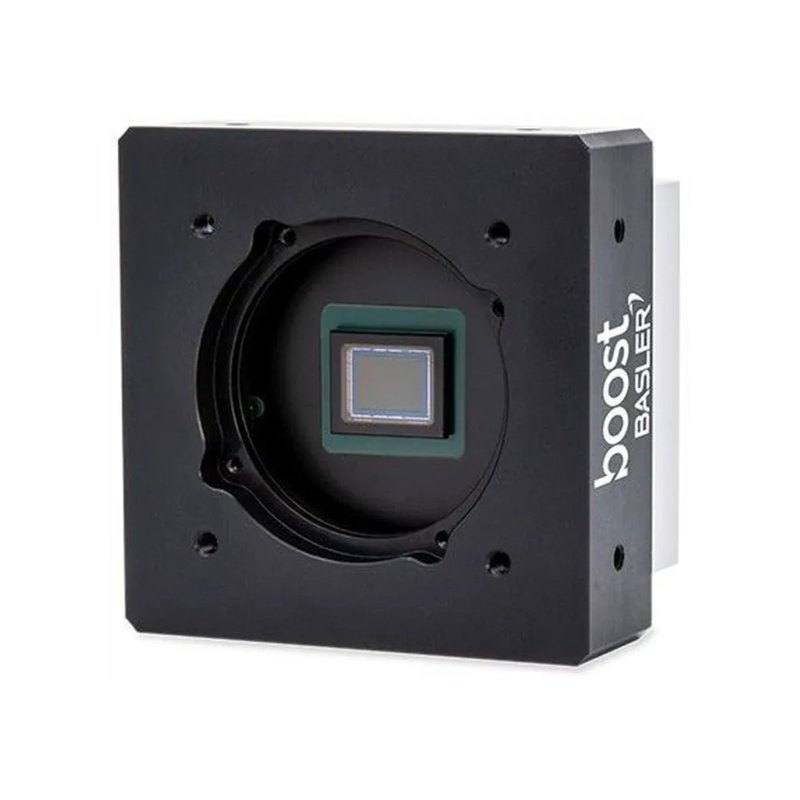
The boA4096-180cm belongs to Basler's boost product line and uses the Sony IMX535 progressive scan CMOS sensor in a 1/1.1" format, achieving 4096 x 3000 pixel resolution at up to 181 fps over dual CXP-12 links (up to 25 Gbps aggregate). The global shutter ensures distortion-free capture of fast-moving objects, and the camera supports 8-, 10-, and 12-bit pixel depth with 70 dB dynamic range. Power can be supplied via Power over CoaXPress (PoCXP) or an external 24 VDC auxiliary supply, and the camera is GenICam and CoaXPress 2.0 compliant. The compact 45 x 80 x 80 mm box housing accepts interchangeable C-, F-, and M42-mount lens adapters and carries IP30 ingress protection.
The Basler boA4096-180cm is built around the Sony IMX535 Pregius S sensor in a 1/1.1" format (11.2 x 8.2 mm active area), delivering 4096 x 3000 pixels at a 2.74 µm pixel pitch — a combination that packs 12 megapixels into a relatively compact optical format. The global shutter architecture captures the entire frame simultaneously, which is essential when inspecting parts on a moving conveyor or tracking fast robot motion: there is no rolling-shutter skew, no object deformation, and no need to freeze the line to take a clean image. The 70 dB dynamic range is sufficient to hold detail in both specular highlights and shadowed recesses on the same frame, a common demand in metal and automotive surface inspection where mixed matte and reflective surfaces appear together.
At full 4096 x 3000 resolution the camera streams up to 181 fps over its dual CoaXPress 2.0 (CXP-12) link — 25 Gbps aggregate — which means it can sustain inspection rates that would saturate a GigE or USB3 camera many times over. Two CXP-12 coax cables carry both data and, via Power over CoaXPress (PoCXP), camera power without additional power wiring, simplifying cable management on large factory lines. An alternative 24 VDC external auxiliary supply is also supported. The camera is GenICam-compliant, so it integrates directly into any standards-based vision framework without vendor-specific adaptors.
The 45 x 80 x 80 mm box housing accepts interchangeable C-mount, F-mount, M42x0.75, and M42x1 lens adapters, giving installers full freedom to pair the 1/1.1" sensor with high-resolution C-mount lenses for close-range inspection or with large-format F-mount or M42 telecentric and macro glass for dimensional gauging over wider fields of view. At 2.74 µm pixels and 4096 columns, the sensor demands lenses that resolve well beyond 100 lp/mm at the image plane to avoid being the limiting factor in measurement accuracy. Power consumption is 12 W and the operating range is 0–50 °C; IP30 ingress protection suits controlled factory environments but is not appropriate for wash-down or outdoor use without an enclosure.
Best for
High-throughput surface defect inspection on flat or curved parts — electronics PCBs, battery electrode sheets, metal stampings, and automotive body panels — where 12 MP detail is needed at line speeds that exceed what slower cameras can sustain at full resolution.
Dimensional measurement and gauging of small parts on moving pallets or robot-held fixtures, exploiting the global shutter to eliminate positional blur and the high pixel count to resolve fine features across a wide field without mosaicking multiple cameras.
Semiconductor wafer and substrate inspection tasks that require fine spatial resolution and the dynamic range to detect both particle contamination and pattern defects in the same acquisition.
High-speed packaging inspection — label print quality, fill-level verification, or code reading on blister packs and cartons — where 100+ fps is necessary to keep pace with modern form-fill-seal equipment without reducing line speed.
Robot guidance and bin-picking applications where the global shutter captures moving robot arms without distortion and the 12 MP image provides enough structural detail for precise 3-D pose estimation with a single camera.
Selection notes
Lens selection is critical: the 1/1.1" (11.2 x 8.2 mm) sensor is larger than the C-mount nominal 2/3" image circle, so C-mount lenses must be rated for at least 1" or ideally 4/3" coverage, otherwise significant corner vignetting and resolution falloff will degrade the outer columns. F-mount and M42 adapters open access to larger-format industrial and telecentric lenses when the full sensor area must be used at consistent MTF.
CoaXPress 2.0 requires a CXP-12 frame grabber with at least two channels — verify grabber compatibility before procurement. PoCXP eliminates a separate power run to the camera, but the grabber's PoCXP power budget must accommodate the camera's 12 W draw; check grabber datasheets for per-port power limits before assuming PoCXP alone is sufficient.
At 181 fps and 12-bit pixel depth the sustained data rate approaches 25 Gbps; the host PC must be sized accordingly — an NVMe storage array or in-memory processing pipeline is typically required to avoid frame drops when recording or processing every frame. For pure inference workloads, GPU processing or FPGA-based grabber pre-processing can relieve the CPU.
IP30 protection means the camera is not sealed against dust or liquids. If the installation environment involves coolant mist, metalworking swarf, or cleaning spray, a sealed IP65/IP67 protective housing around the camera is mandatory to protect the sensor and electronics.
The 2.74 µm pixel pitch combined with the 1/1.1" format positions this sensor in a demanding regime: diffraction-limited optics are needed at small apertures, and depth of field at close working distances is shallow. Lighting must be bright enough to allow short exposure times that freeze motion at 181 fps — continuous LED illumination at this frame rate typically requires a strobe controller to boost instantaneous intensity and maintain thermal stability.
Matched automatically by: lens mount fits the camera mount · lens image circle covers the camera sensor — this camera: C-mount, F-mount, M42x0.75, M42x1 (interchangeable adapters) · 1/1.1" (11.2 x 8.2 mm) sensor.
By category
All 90C-mount lenses 66Telecentric lenses 24
By brand
All 90Basler 34iRAYPLE 26Omron / Sentech 24Datalogic / Datasensing 6
Get a first image quickly with the pylon Viewer, then move into the pylon SDK for your application. These cameras are GenICam/GenTL-compliant, so any compliant vision software can drive them as well.
Download and install the pylon Camera Software Suite for your OS from Basler. This provides the pylon Viewer, the GenTL transport-layer producers and the pylon SDK (C/C++/.NET/Python). On Windows the installer adds the needed drivers; on Linux follow the included setup notes for USB and network permissions.
2. Connect the camera and check the link
Cable the camera to its matching interface: GigE Vision to a GigE port (use a quality cable and, ideally, a dedicated NIC with jumbo frames enabled), USB3 Vision to a USB 3.x port with the supplied cable, or CoaXPress to the frame grabber. Provide power where required (PoE, USB bus power, or PoCXP). Open the pylon Viewer and confirm the camera appears in the device list; for GigE, make sure the camera and NIC are on the same subnet.
3. Grab a first image and set exposure, gain and pixel format
Select the camera in the pylon Viewer and start a continuous grab. Adjust exposure time and gain until the image is well exposed (avoid clipped highlights), set the pixel format (e.g. Mono8 or a Bayer/RGB format), and focus the lens. Use a test pattern if the lens or scene is not ready yet.
4. Configure triggering and acquisition
Decide between free-run and triggered acquisition. For synchronized capture, set the trigger source (software or a hardware line on the I/O connector), trigger mode and any debounce or exposure mode, then verify timing. Note the parameter names you change in the Viewer feature tree, as you will reuse them in code.
5. Move to the SDK or a GenICam-compliant library
Recreate your settings in code with the pylon SDK (C, C++, .NET or Python) to open the device, apply the same features and pull frames into your pipeline; pylon vTools and pylon AI can add processing blocks. Because the cameras are GenICam/GenTL standard, third-party vision libraries work too. Once the image stream is stable, you can route frames to a deep-learning inspection such as Rosepetal for automated defect detection.
Frequently asked questions
Power over CoaXPress (PoCXP) is fully supported, so if your CXP-12 frame grabber provides PoCXP at adequate power (the camera consumes 12 W), no separate supply is needed. The 24 VDC auxiliary input is an alternative — useful when the grabber does not supply PoCXP or when its per-port power budget cannot meet the camera's 12 W draw.
Yes — 181 fps is the specified rate at full 4096 x 3000 resolution over the dual CXP-12 link. The aggregate 25 Gbps bandwidth of two CXP-12 channels is what makes this possible; a single-link configuration would limit throughput to roughly half that frame rate at full resolution.
The camera ships with a C-mount adapter and accepts interchangeable F-mount, M42x0.75, and M42x1 adapters. For the full 11.2 x 8.2 mm sensor area, use lenses certified for at least 1" image circle — ideally 4/3" coverage. F-mount and M42 adapters are the preferred path for telecentric and large-format macro lenses used in gauging applications.
The boA4096-180cm uses a global shutter, meaning all pixels are exposed simultaneously. This is essential when the object or camera is moving during exposure — rolling shutter cameras read out row-by-row and produce geometric distortion (skew, wobble) on moving parts. If your parts are stationary during the shot, rolling shutter may be acceptable in a different model, but for conveyor, robot, or any motion scenario, global shutter is the correct choice.
The Sony IMX535 sensor in this camera provides 70 dB dynamic range. The camera supports 8-bit, 10-bit, and 12-bit pixel depth output modes, giving latitude in trading bit depth for throughput. Consult Basler's pylon documentation for any multi-exposure HDR features available through the GenICam interface, as the product specs confirm only the base 70 dB figure and the supported pixel depths.