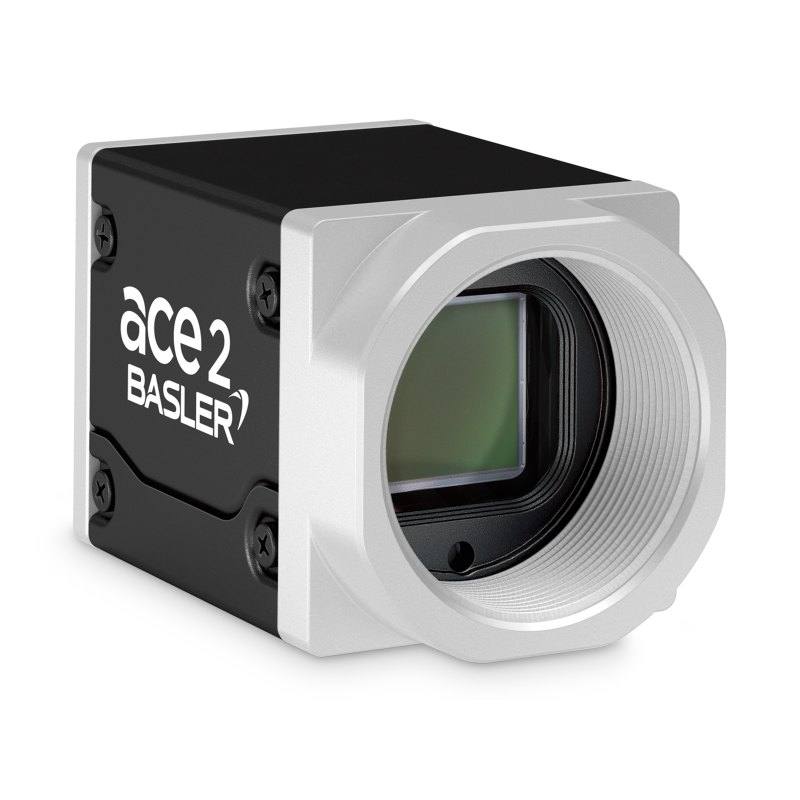
The Basler a2A2840-86cm is a high-speed area scan camera from the ace 2 V series featuring the Sony IMX546 progressive-scan CMOS sensor in a 2/3" format with 2.74 µm pixels. It delivers up to 86.4 fps at 8-bit depth over a single CXP-12 (CoaXPress 2.0) link with Power over CoaXPress (PoCXP). The global shutter captures 2856 x 2848 pixels in monochrome and supports 8, 10, and 12-bit pixel depths with free-run, hardware, and software trigger modes. Housed in a compact 29 x 29 mm footprint weighing under 85 g, it includes GenICam compliance and interfaces via a C-mount lens.
The Basler a2A2840-86cm is built around the Sony IMX546 Pregius S progressive-scan CMOS sensor in a 2/3" format (7.78 mm × 7.78 mm sensor dimensions), delivering 2856 × 2848 pixels — just over 8.1 MP — at a native pixel pitch of 2.74 µm. The global shutter architecture means every pixel integrates light simultaneously, so fast-moving parts, conveyor belts, or robot-held components produce no rolling-shutter skew or spatial distortion in a single frame. At 86.4 fps in 8-bit mode, with 10-bit and 12-bit depths also available, the camera gives system integrators the flexibility to trade dynamic-range headroom against throughput: run 8-bit at full speed for high-cycle inspection lines, or switch to 12-bit when subtle grey-level contrast is needed to resolve low-contrast surface defects. The combination of 8 MP resolution and 86 fps is comparatively rare on a single CXP-12 link and makes this camera well suited to production lines that need both spatial detail and high part throughput simultaneously.
The camera interfaces exclusively over CoaXPress 2.0 (CXP-12), a single-coax interface that carries 12.5 Gbit/s of data plus Power over CoaXPress (PoCXP, 24 VDC) on one 75-ohm coaxial cable. This eliminates separate power cabling and simplifies routing in cabinet-dense or multi-axis gantry installations. The 29 × 29 × 36.3 mm body weighs 85 g and consumes only 3.2 W — attributes that matter when mounting to robot end-effectors or positioning arms where mass and cable flex are critical concerns. Trigger modes include free-run, hardware trigger, and software trigger; combined with GenICam compliance, integration into existing vision runtimes (Halcon, VisionPro, Cognex Designer, or custom CoaXPress SDKs) follows a standardised register map without vendor-specific workarounds. The IP30 rating is appropriate for controlled indoor environments such as cleanrooms, electronics lines, and enclosed inspection cells, but is not suitable for direct wash-down or dusty open environments without additional enclosure protection.
The C-mount interface covers the full 2/3" image circle without vignetting when a correctly rated C-mount lens is used. At 2.74 µm pixel pitch, lens resolution demands are high: to avoid the sensor outresolving the optic, choose lenses specified to at least 100–120 lp/mm at the image plane across the 2/3" format. Telecentricity is not a property of the camera itself but becomes relevant at the lens selection stage for dimensional-measurement applications: a bilateral telecentric lens will eliminate parallax error across the depth of field when gauging part dimensions. The compact body and standard C-mount make the camera compatible with a wide range of fixed-focal-length and macro lenses designed for 2/3" sensors. Lighting pairing should account for the global shutter's ability to strobe at short exposures — a pulsed LED strobe controller keyed to the hardware trigger line can achieve effective flash durations well below the nominal frame exposure, freezing motion further and improving contrast on reflective metal or semiconductor surfaces.
Best for
High-speed surface inspection on fast conveyors where both resolution and throughput matter — 8.1 MP at 86.4 fps detects fine scratches, pits, or contamination on metal, semiconductor wafers, or battery electrodes without reducing line speed.
Dimensional measurement of small components such as PCB features, connector pins, or stamped metal parts, where the 2.74 µm pixel pitch provides fine spatial sampling and the global shutter eliminates geometric distortion from part motion.
Robot guidance and pick-and-place alignment in automotive or electronics assembly, where the 85 g body and PoCXP single-cable routing simplify end-effector integration and the global shutter delivers artefact-free images of moving parts.
Pharmaceutical and packaging line OCR/OCV and barcode reading, where 8 MP resolution provides enough pixels across characters and code elements to achieve high read rates even on small or densely printed labels at speed.
Traceability and code reading on semiconductor or electronics lines where direct-part marks (DPM) require high pixel density and fast frame rates to keep pace with indexing equipment.
Selection notes
CoaXPress 2.0 (CXP-12) requires a compatible frame grabber; confirm the host PC or embedded platform has a CXP-12-capable card before specifying this camera. GigE or USB3 Vision systems cannot directly interface with this model.
The 2/3" sensor format and 2.74 µm pixel pitch set the minimum optical specification for the lens: use only lenses rated for 2/3" image circle and capable of resolving the pixel pitch (target ≥ 100 lp/mm) to avoid softening the native sensor resolution.
IP30 protection is adequate for enclosed, dry inspection cells; if the installation environment involves coolant mist, metal swarf, or wash-down cycles, the camera must be housed in an appropriately rated protective enclosure.
PoCXP supplies power at 24 VDC over the coax link, so no separate power supply is needed at the camera end — however, the frame grabber or CXP hub must explicitly support PoCXP output at sufficient current for 3.2 W draw.
At 86.4 fps, raw data throughput is approximately 0.70 GB/s (8-bit); ensure the host system CPU, RAM bandwidth, and storage I/O can sustain this rate if recording full-frame sequences, or budget for hardware ROI or decimation to reduce load.
Specifications: General
Brand
Basler
Camera type
Area Scan
Specifications: Sensor
Resolution
8.1 MP
Horizontal resolution
2856 px
Mono / color
Monochrome
Sensor manufacturer
Sony Pregius S
Sensor model
Sony IMX546-AAMJ-C
Shutter
Global Shutter
Sensor size
2/3" (7.78 mm × 7.78 mm)
Pixel size
2.74 µm × 2.74 µm
Specifications: Performance
FPS
86.4 fps (8-bit)
Specifications: Interface
Interface
CoaXPress 2.0 (CXP-12)
Protocols
GenICam, CoaXPress 2.0
Specifications: Optics
Mount
C-mount
Specifications: Electrical
Power
PoCXP (Power over CoaXPress, 24 VDC)
Power consumption
3.2 W
Specifications: Environment
IP rating
IP30
Operating temperature
-10 to 50 °C
Specifications: Mechanical
Dimensions
29 × 29 × 36.3 mm (body)
Weight
85 g
Applications this camera is commonly selected for. Open one to see the full recommended hardware and approach.
Matched automatically by: lens mount fits the camera mount · lens image circle covers the camera sensor — this camera: C-mount · 2/3" (7.78 mm × 7.78 mm) sensor.
By category
All 198C-mount lenses 135Telecentric lenses 60F-mount / large-format lenses 3
By brand
All 198Omron / Sentech 66Basler 59iRAYPLE 48Datalogic / Datasensing 25
Get a first image quickly with the pylon Viewer, then move into the pylon SDK for your application. These cameras are GenICam/GenTL-compliant, so any compliant vision software can drive them as well.
Download and install the pylon Camera Software Suite for your OS from Basler. This provides the pylon Viewer, the GenTL transport-layer producers and the pylon SDK (C/C++/.NET/Python). On Windows the installer adds the needed drivers; on Linux follow the included setup notes for USB and network permissions.
2. Connect the camera and check the link
Cable the camera to its matching interface: GigE Vision to a GigE port (use a quality cable and, ideally, a dedicated NIC with jumbo frames enabled), USB3 Vision to a USB 3.x port with the supplied cable, or CoaXPress to the frame grabber. Provide power where required (PoE, USB bus power, or PoCXP). Open the pylon Viewer and confirm the camera appears in the device list; for GigE, make sure the camera and NIC are on the same subnet.
3. Grab a first image and set exposure, gain and pixel format
Select the camera in the pylon Viewer and start a continuous grab. Adjust exposure time and gain until the image is well exposed (avoid clipped highlights), set the pixel format (e.g. Mono8 or a Bayer/RGB format), and focus the lens. Use a test pattern if the lens or scene is not ready yet.
4. Configure triggering and acquisition
Decide between free-run and triggered acquisition. For synchronized capture, set the trigger source (software or a hardware line on the I/O connector), trigger mode and any debounce or exposure mode, then verify timing. Note the parameter names you change in the Viewer feature tree, as you will reuse them in code.
5. Move to the SDK or a GenICam-compliant library
Recreate your settings in code with the pylon SDK (C, C++, .NET or Python) to open the device, apply the same features and pull frames into your pipeline; pylon vTools and pylon AI can add processing blocks. Because the cameras are GenICam/GenTL standard, third-party vision libraries work too. Once the image stream is stable, you can route frames to a deep-learning inspection such as Rosepetal for automated defect detection.
Frequently asked questions
The camera delivers 86.4 fps at 8-bit pixel depth. It also supports 10-bit and 12-bit output modes, which typically reduce maximum frame rate depending on the CXP-12 link bandwidth allocation.
Yes. The camera uses Power over CoaXPress (PoCXP) at 24 VDC, drawing 3.2 W. A single coaxial cable from a PoCXP-capable frame grabber or hub carries both data and power, so no additional power wiring is needed at the camera.
Yes. The global shutter exposes all 2856 × 2848 pixels simultaneously, which means there is no row-by-row readout delay. Parts moving across the field of view during exposure produce no spatial skew — unlike rolling-shutter sensors where fast motion appears sheared.
The camera uses a standard C-mount. The Sony IMX546 sensor measures 7.78 mm × 7.78 mm (2/3" format), so the chosen lens must cover the 2/3" image circle without vignetting and should be capable of resolving the 2.74 µm pixel pitch.
The camera is rated for -10 to 50 °C operating temperature and carries an IP30 ingress-protection rating, which guards against solid objects larger than 2.5 mm but provides no protection against liquids. Use in dry, enclosed environments.