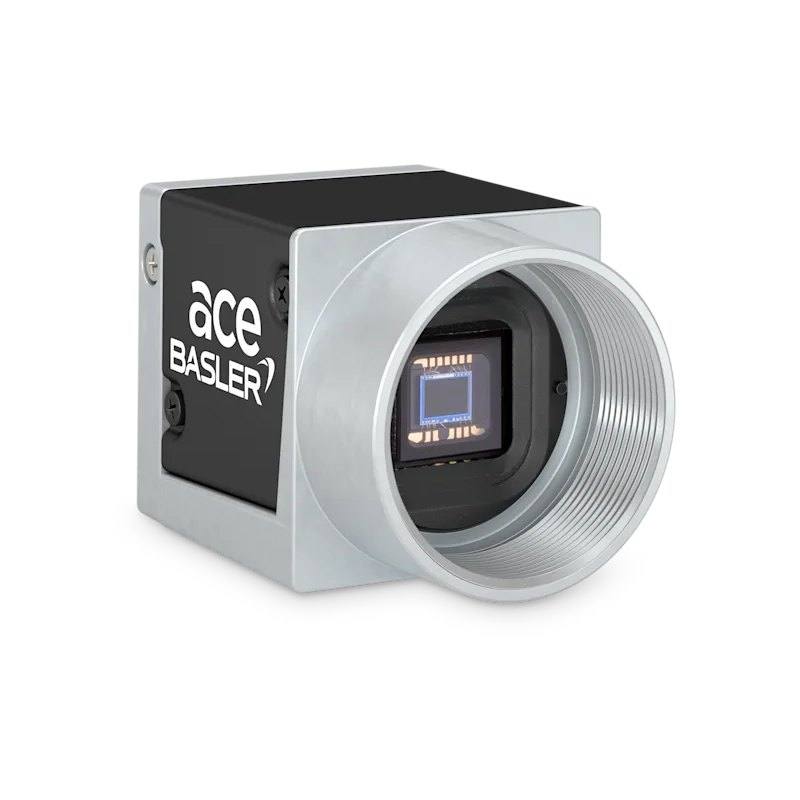
The Basler ace U acA2440-75um/uc are compact box-style area scan cameras featuring the Sony IMX250 2/3" progressive-scan CMOS sensor with 3.45 µm pixel pitch and global shutter. They deliver 5 MP resolution (2448 × 2048 px) at up to 75 fps over a USB 3.0 (SuperSpeed, 5 Gbit/s) interface compliant with USB3 Vision and GenICam 2.x standards. The cameras are powered entirely via the USB bus (3.2–3.4 W typical) and feature a C-mount lens interface, opto-coupled I/O lines, and a compact 29 × 29 × 29 mm housing weighing 80 g. IP30 protection class is certified, and both models carry CE/FCC/UL/UKCA/EAC compliance.
The acA2440-75um/uc is built around Sony's IMX250 Pregius global shutter CMOS sensor in a 2/3" optical format, delivering 2448 × 2048 pixels at a 3.45 µm pixel pitch. Global shutter means every pixel integrates simultaneously, so fast-moving parts — blister packs on a conveyor, PCBs under robotic handling, automotive stampings — are captured without any rolling-shutter skew or motion blur. At 5 MP the sensor resolves fine detail while the 2/3" format gives installers access to a large catalogue of well-corrected C-mount lenses including telecentric objectives, which is essential when perspective error must be eliminated for dimensional checks.
Over USB 3.0 SuperSpeed the camera sustains the full 75 fps at 2448 × 2048 — approximately 375 megapixels per second — without any external frame-grabber. The USB3 Vision / GenICam 2.x (PFNC 2.x, SFNC 2.x) compliance means the camera works with any conformant SDK (Basler pylon, MVTec Halcon, National Instruments Vision Acquisition Software, and others) and host-side programming is reduced to standard feature nodes rather than vendor register writes. Bus-powered operation at only 3.2 W (mono) / 3.4 W (color) eliminates a dedicated power supply and simplifies cable routing in compact inspection stations or cobots where panel space is scarce.
The 29.3 × 29 × 29 mm cube housing weighing 80 g slots into tight mechanical fixtures, robot wrists, or multi-camera arrays without imposing significant moment loads. IP30 protection handles solid-particle ingress down to 2.5 mm and is appropriate for typical electronics assembly and pharmaceutical line environments, while the 0–50 °C operating range covers standard factory ambient conditions. Opto-coupled I/O lines accept hardware trigger signals from PLCs or photoelectric sensors for deterministic exposure timing, and the strobe output can drive an LED controller in synchronized flash mode to freeze motion and maximise dynamic range simultaneously. The color variant (acA2440-75uc) uses the Bayer-pattern IMX250 and is suited to label color verification or pharmaceutical cap-color inspection without adding a separate color sensor to the BOM.
Best for
High-throughput PCB and SMT solder-joint inspection where global shutter eliminates smear on boards moving at line speed and 5 MP resolution resolves fine pad geometry within a single field of view
Pharmaceutical blister-pack and label inspection combining code reading, print verification, and color-correct presence/absence checks — the color variant handles cap-color grading; the mono variant pairs with a ring or coaxial LED for surface-defect contrast
Dimensional gauging of machined or stamped parts with a telecentric C-mount lens, where the 2/3" sensor format covers the full image circle of most 2/3" telecentrics and global shutter removes measurement uncertainty from part vibration
Logistics barcode and 2D matrix decoding on sortation belts running at high speed, exploiting 75 fps for multiple decode attempts per label pass and hardware trigger for exact timing against encoder pulses
Robot-guidance and bin-picking cells where the 80 g mass and 29.3 × 29 × 29 mm form factor allow direct mounting on collaborative-robot tool flanges, and USB bus power avoids a separate supply cable in the drag chain
Selection notes
Interface reach: USB 3.0 passive copper cables typically achieve reliable operation to 5 m; active optical or active copper extension cables can extend this to roughly 10–15 m. If the camera must sit more than 10 m from the host PC — e.g., a long conveyor line — consider a GigE variant instead; USB is the right choice for desktop inspection stations, robot cells, and close-coupled fixtures.
Lens selection must respect the 2/3" image circle: a lens specified for 1/1.8" or smaller will vignette at the corners of the 2448 × 2048 array. Telecentric lenses for gauging should be sourced in 2/3" format; standard C-mount machine-vision lenses from f/2.0–f/2.8 work well for texture/defect applications.
Lighting and trigger pairing: the opto-coupled I/O lines provide hardware trigger input from PLCs or photoelectric sensors for deterministic exposure timing. For highest SNR on dark or low-contrast surfaces, pair with a strobed LED controller — the camera's strobe output line can directly gate a compatible driver, keeping exposure times short at 75 fps without continuous LED heating.
IP30 rating protects against solid objects larger than 2.5 mm but provides no liquid or dust ingress protection. In wash-down or mist environments (food, beverage) an IP67-rated enclosure with a flat glass window is required; factor the window's refractive shift into the optical working distance calculation.
Mono vs. color: the mono (acA2440-75um) has higher effective sensitivity compared with the color (acA2440-75uc) after Bayer demosaicing, making it preferable for any monochrome inspection task where sensitivity or SNR is critical. Use the color variant only when hue discrimination is a required inspection criterion.
Specifications: General
Brand
Basler
Camera type
Area Scan
Specifications: Sensor
Resolution
5 MP
Horizontal resolution
2448 × 2048 px
Mono / color
Mono (acA2440-75um) / Color (acA2440-75uc)
Sensor manufacturer
Sony Pregius
Sensor model
Sony IMX250LLR-C (mono) / IMX250LQR-C (color)
Shutter
Global Shutter
Sensor size
2/3" (8.45 mm × 7.07 mm, 11.02 mm diagonal)
Pixel size
3.45 µm × 3.45 µm
Specifications: Performance
FPS
75 fps (max at full resolution)
Specifications: Interface
Interface
USB 3.0 (SuperSpeed, 5 Gbit/s)
Protocols
USB3 Vision, GenICam 2.x (PFNC 2.x, SFNC 2.x)
Specifications: Optics
Mount
C-Mount
Specifications: Electrical
Power
Via USB 3.0 bus (3.2 W mono / 3.4 W color typical)
Power consumption
3.2 W
Specifications: Environment
IP rating
IP30
Operating temperature
0 – 50 °C
Specifications: Mechanical
Dimensions
29.3 × 29 × 29 mm
Weight
80 g
Housing material
Box
Applications this camera is commonly selected for. Open one to see the full recommended hardware and approach.
Matched automatically by: lens mount fits the camera mount · lens image circle covers the camera sensor — this camera: C-Mount · 2/3" (8.45 mm × 7.07 mm, 11.02 mm diagonal) sensor.
By category
All 198C-mount lenses 135Telecentric lenses 60F-mount / large-format lenses 3
By brand
All 198Omron / Sentech 66Basler 59iRAYPLE 48Datalogic / Datasensing 25
Get a first image quickly with the pylon Viewer, then move into the pylon SDK for your application. These cameras are GenICam/GenTL-compliant, so any compliant vision software can drive them as well.
Download and install the pylon Camera Software Suite for your OS from Basler. This provides the pylon Viewer, the GenTL transport-layer producers and the pylon SDK (C/C++/.NET/Python). On Windows the installer adds the needed drivers; on Linux follow the included setup notes for USB and network permissions.
2. Connect the camera and check the link
Cable the camera to its matching interface: GigE Vision to a GigE port (use a quality cable and, ideally, a dedicated NIC with jumbo frames enabled), USB3 Vision to a USB 3.x port with the supplied cable, or CoaXPress to the frame grabber. Provide power where required (PoE, USB bus power, or PoCXP). Open the pylon Viewer and confirm the camera appears in the device list; for GigE, make sure the camera and NIC are on the same subnet.
3. Grab a first image and set exposure, gain and pixel format
Select the camera in the pylon Viewer and start a continuous grab. Adjust exposure time and gain until the image is well exposed (avoid clipped highlights), set the pixel format (e.g. Mono8 or a Bayer/RGB format), and focus the lens. Use a test pattern if the lens or scene is not ready yet.
4. Configure triggering and acquisition
Decide between free-run and triggered acquisition. For synchronized capture, set the trigger source (software or a hardware line on the I/O connector), trigger mode and any debounce or exposure mode, then verify timing. Note the parameter names you change in the Viewer feature tree, as you will reuse them in code.
5. Move to the SDK or a GenICam-compliant library
Recreate your settings in code with the pylon SDK (C, C++, .NET or Python) to open the device, apply the same features and pull frames into your pipeline; pylon vTools and pylon AI can add processing blocks. Because the cameras are GenICam/GenTL standard, third-party vision libraries work too. Once the image stream is stable, you can route frames to a deep-learning inspection such as Rosepetal for automated defect detection.
Frequently asked questions
Yes. The acA2440-75um draws 3.2 W and the acA2440-75uc draws 3.4 W (typical), both within the USB 3.0 bus power budget. A standard USB 3.0 port on an industrial PC or hub powers the camera without any additional power connector or cable.
Yes, critically so for moving targets. A rolling shutter reads lines sequentially over the frame period; at 75 fps that is up to approximately 13 ms of skew across the frame height. The IMX250's global shutter exposes all 2448 × 2048 pixels simultaneously, so a part travelling at speed accumulates zero geometric distortion regardless of exposure time, provided the exposure itself is short enough to freeze motion.
Passive copper cables typically achieve reliable operation to 5 m. Active optical or active copper extension cables can extend this to roughly 10–15 m. Beyond that distance, a GigE Vision camera should be evaluated instead.
The camera is fully compliant with USB3 Vision and GenICam 2.x (PFNC 2.x, SFNC 2.x), which are open industry standards. It works with any conformant SDK including Basler pylon, MVTec Halcon, National Instruments Vision Acquisition Software, and OpenCV via the GenICam transport layer — no Basler-specific wrapper is required.
The camera uses a standard C-mount. This is the most widely supported mount in industrial machine vision, giving access to a broad range of fixed-focal-length, macro, and telecentric lenses. For gauging and measurement applications, 2/3" format telecentric C-mount lenses from suppliers such as Opto Engineering, Sill Optics, or Edmund Optics are compatible and will cover the full sensor area without vignetting.