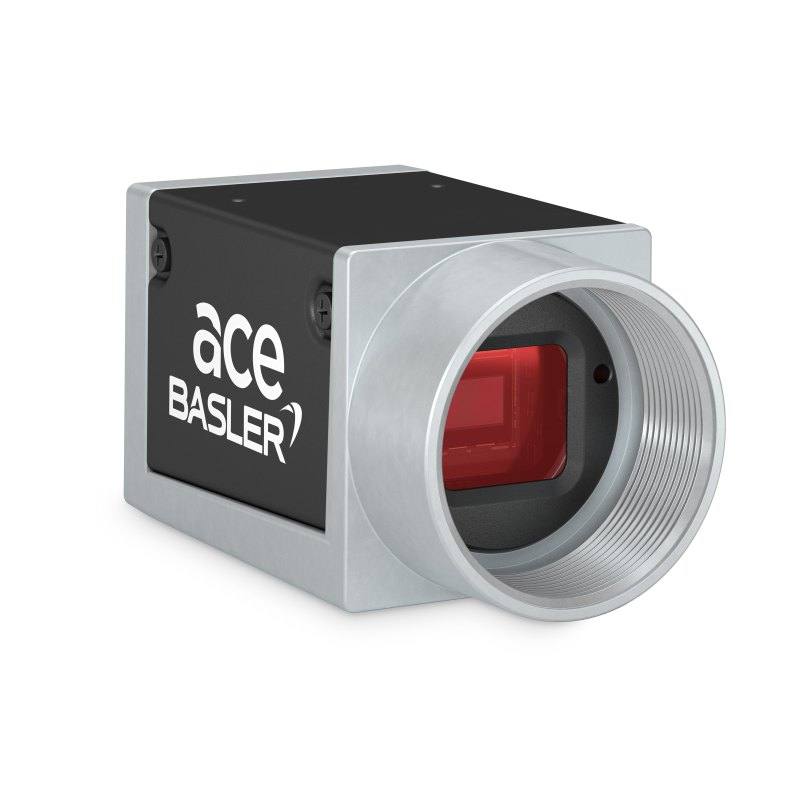
The Basler acA2500-20gm/gc are GigE Vision industrial area scan cameras from the ace U series, delivering 2590 × 2048 pixel resolution (5 MP) at up to 21 fps using the onsemi PYTHON 5000 (NOIP1SE5000A) progressive scan CMOS sensor with a 1-inch format and 4.8 µm square pixels. Both models feature a global shutter for distortion-free imaging of fast-moving objects and support Power over Ethernet (IEEE 802.3af) as well as 12–24 VDC auxiliary power. The monochrome variant (acA2500-20gm) offers 55% quantum efficiency, 57 dB dynamic range, and 39.1 dB SNR, while the color variant (acA2500-20gc) includes an IR cut filter. Both cameras comply with GigE Vision and GenICam standards and are housed in a compact 42 × 29 × 29 mm C-mount body weighing approximately 90 g.
Brand
Basler
Camera type
Area Scan
Interface
GigE (10/100/1000 Mbit/s)
Resolution
5 MP
Horizontal resolution
2592 px (per Basler docs); 2590 px per Basler shop pages — both appear in Basler sources
The Basler acA2500-20gm/gc is built around the onsemi PYTHON 5000 (NOIP1SE5000A) CMOS sensor in a 1-inch format, delivering a 2590 x 2048 pixel (5 MP) image with 4.8 µm square pixels at up to 21 fps. The global shutter architecture is the defining characteristic for inline inspection work: every pixel integrates simultaneously, so fast-moving parts on a conveyor or indexing carousel are captured without the rolling-shutter skew or motion smear that would corrupt dimensional readings or OCR character edges. At 21 fps full-frame over GigE, the camera can sustain inspection rates well into the hundreds of parts per minute depending on conveyor spacing. The 57 dB dynamic range (monochrome variant) and 39.1 dB SNR are solid figures for a 5 MP camera at this price tier, meaning both specular highlights and shadowed recesses on a machined part can be resolved in a single frame without HDR sequencing.
The GigE Vision / GenICam-compliant interface is a practical advantage in factory environments: standard Cat5e/Cat6 cable runs up to 100 m without repeaters, existing network switches can fan out multiple cameras to a single frame-grabber PC, and Power over Ethernet (IEEE 802.3af) eliminates a dedicated power cable run to the mounting position. Where PoE infrastructure is unavailable, the I/O connector accepts 12–24 VDC, matching virtually every PLC and industrial power rail. The compact 42 x 29 x 29 mm box body weighing 90 g integrates into tight mounting brackets without adding lever-arm vibration, and 3.9 W total consumption keeps thermal management simple even in enclosed housings. The IP30 rating means the camera is suitable for controlled indoor environments but requires a protective enclosure if coolant mist, wash-down, or heavy particulate is present.
The C-mount lens interface gives access to the broadest range of industrial optics. With a 1-inch sensor (15.86 mm diagonal, 12.44 x 9.83 mm active area) and 4.8 µm pixels, installers should select a lens that resolves down to at least 2 lp/px at the chosen working distance — roughly 100 lp/mm at the sensor plane — and covers the full 1-inch image circle to avoid vignetting at the corners. Telecentric lenses are worth evaluating for dimensional gauging applications where part height variation would otherwise introduce magnification error. For surface and packaging inspection the camera pairs naturally with coaxial, dome, or bar LED lighting; the monochrome variant's 55% quantum efficiency in the visible spectrum makes it receptive to broadband white LEDs as well as narrowband 850 nm NIR illumination for contrast enhancement on transparent packaging films or low-contrast label print.
Best for
Inline surface defect inspection on machined metal or plastic parts where global shutter prevents motion blur at conveyor speeds up to several hundred mm/s
Label and packaging print verification (OCR/OCV) requiring 5 MP spatial resolution to resolve fine text and 1D/2D codes across the full label area in a single frame
Dimensional measurement and robot guidance in automotive or electronics assembly where GigE cable reach and PoE simplify installation at the end of a robot arm or gantry
Pharmaceutical and food-and-beverage packaging line inspection — blister packs, label presence, fill-level check — where the compact body fits inside existing guarding and PoE reduces cable clutter
Logistics sortation and traceability: reading DPM codes, barcodes, or QR codes on a fast-moving belt where 21 fps full-frame throughput and global shutter prevent decode failures
Selection notes
Cable infrastructure: GigE supports 100 m cable runs and PoE (IEEE 802.3af) is available, but confirm your switch or NIC supplies PoE and that Jumbo Frames are enabled on the network stack — dropped packets at high frame rates are a common commissioning issue on untuned GigE networks.
Lens image-circle coverage: the 1-inch sensor (15.86 mm diagonal) is larger than the 2/3-inch format that many standard C-mount industrial lenses cover; verify the selected lens is rated for 1-inch coverage or expect corner shading and resolution fall-off on the outer megapixels.
Lighting and IP protection: the camera's IP30 enclosure is not sealed against liquids or dust — if the application involves cutting fluid, wash-down, or dusty grinding environments, pair the camera with a sealed housing or choose a higher-IP model. LED strobe controllers synchronized via the camera's I/O trigger line will freeze motion and extend LED lifetime versus continuous mode.
Monochrome vs. color selection: the acA2500-20gm delivers higher light sensitivity and is the preferred choice for any application that uses narrowband or NIR illumination for contrast control. Choose the acA2500-20gc only when hue-based defect discrimination (e.g., color-coding verification, label color matching) is a hard requirement — the Bayer mosaic reduces effective spatial resolution and adds demosaicing latency.
Bandwidth planning for multi-camera setups: one GigE camera at 5 MP / 21 fps generates approximately 111 MB/s of raw pixel data at 8-bit depth (~891 Mbit/s), which effectively saturates a 1 GbE link at full frame rate. Use hardware trigger and ROI (region of interest) to reduce bandwidth, or plan for a dedicated GigE NIC per camera if full-frame continuous acquisition is required.
Specifications: General
Brand
Basler
Camera type
Area Scan
Specifications: Sensor
Resolution
5 MP
Horizontal resolution
2592 px (per Basler docs); 2590 px per Basler shop pages — both appear in Basler sources
Mono / color
Mono (acA2500-20gm) / Color (acA2500-20gc)
Sensor manufacturer
onsemi
Sensor model
onsemi PYTHON 5000 (NOIP1SE5000A)
Shutter
Global Shutter
Sensor size
1" (12.44 × 9.83 mm, 15.86 mm diagonal)
Pixel size
4.8 × 4.8 µm
Specifications: Performance
FPS
21 fps (fast readout) / 20 fps (normal readout)
Specifications: Interface
Interface
GigE (10/100/1000 Mbit/s)
Protocols
GigE Vision, GenICam
Specifications: Optics
Mount
C-mount
Specifications: Electrical
Power
PoE (IEEE 802.3af) or 12–24 VDC via I/O connector
Power consumption
3.9 W
Specifications: Environment
IP rating
IP30
Operating temperature
0–50 °C
Specifications: Mechanical
Dimensions
12.44 × 9.83 mm
Weight
90 g
Housing material
Box
Applications this camera is commonly selected for. Open one to see the full recommended hardware and approach.
Matched automatically by: lens mount fits the camera mount · lens image circle covers the camera sensor — this camera: C-mount · 1" (12.44 × 9.83 mm, 15.86 mm diagonal) sensor.
By category
All 90C-mount lenses 66Telecentric lenses 24
By brand
All 90Basler 34iRAYPLE 26Omron / Sentech 24Datalogic / Datasensing 6
Get a first image quickly with the pylon Viewer, then move into the pylon SDK for your application. These cameras are GenICam/GenTL-compliant, so any compliant vision software can drive them as well.
Download and install the pylon Camera Software Suite for your OS from Basler. This provides the pylon Viewer, the GenTL transport-layer producers and the pylon SDK (C/C++/.NET/Python). On Windows the installer adds the needed drivers; on Linux follow the included setup notes for USB and network permissions.
2. Connect the camera and check the link
Cable the camera to its matching interface: GigE Vision to a GigE port (use a quality cable and, ideally, a dedicated NIC with jumbo frames enabled), USB3 Vision to a USB 3.x port with the supplied cable, or CoaXPress to the frame grabber. Provide power where required (PoE, USB bus power, or PoCXP). Open the pylon Viewer and confirm the camera appears in the device list; for GigE, make sure the camera and NIC are on the same subnet.
3. Grab a first image and set exposure, gain and pixel format
Select the camera in the pylon Viewer and start a continuous grab. Adjust exposure time and gain until the image is well exposed (avoid clipped highlights), set the pixel format (e.g. Mono8 or a Bayer/RGB format), and focus the lens. Use a test pattern if the lens or scene is not ready yet.
4. Configure triggering and acquisition
Decide between free-run and triggered acquisition. For synchronized capture, set the trigger source (software or a hardware line on the I/O connector), trigger mode and any debounce or exposure mode, then verify timing. Note the parameter names you change in the Viewer feature tree, as you will reuse them in code.
5. Move to the SDK or a GenICam-compliant library
Recreate your settings in code with the pylon SDK (C, C++, .NET or Python) to open the device, apply the same features and pull frames into your pipeline; pylon vTools and pylon AI can add processing blocks. Because the cameras are GenICam/GenTL standard, third-party vision libraries work too. Once the image stream is stable, you can route frames to a deep-learning inspection such as Rosepetal for automated defect detection.
Frequently asked questions
The camera delivers up to 21 fps in fast-readout mode and 20 fps in normal-readout mode at the full 2590 x 2048 pixel resolution. Reducing the region of interest (ROI) will increase frame rate proportionally.
No, if a PoE-capable switch or NIC is available. The camera is compliant with IEEE 802.3af PoE (up to 15.4 W available; the camera draws 3.9 W), so a single Ethernet cable provides both data and power. Alternatively, 12–24 VDC can be supplied via the auxiliary I/O connector.
Physically yes — the C-mount thread is compatible — but optically a 2/3-inch lens will not cover the full 1-inch sensor. You will see vignetting and resolution degradation in the outer corners. Lenses rated for 1-inch or larger image circles are required for full-sensor performance.
Yes. The acA2500-20gm is a monochrome sensor without an IR cut filter, making it usable with NIR LED illumination (typically 850 nm or 940 nm). The color variant (acA2500-20gc) includes an IR cut filter, blocking wavelengths above approximately 650 nm.
IP30 means the housing prevents solid objects larger than 2.5 mm from contacting internal components, but provides no protection against liquids or fine dust. Installations near coolant spray, wash-down zones, or heavy particulate must use a sealed protective enclosure around the camera.