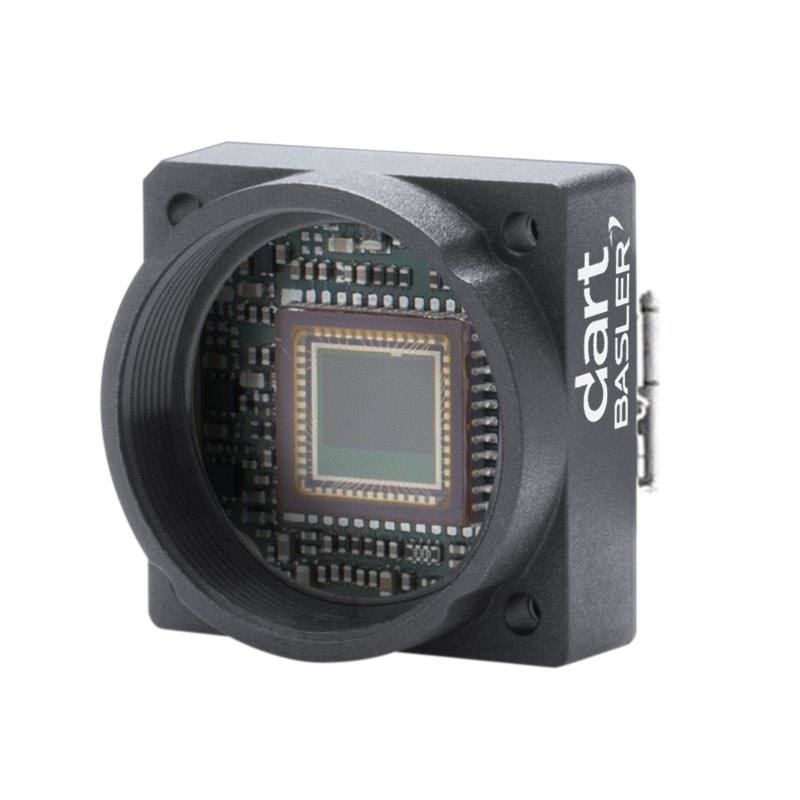
The Basler daA1600-60um is a compact board-level camera in the dart Classic family, featuring a 1/1.8" e2V EV76C570 CMOS global shutter sensor at 1600x1200 (2 MP) resolution running at up to 60 fps. It connects via USB 3.0 (5 Gbit/s SuperSpeed) using a Micro-B connector, which also supplies 5 VDC power at 1.3 W typical consumption. The camera outputs 8-bit or 12-bit monochrome pixel data and is compliant with USB3 Vision and GenICam 2.x protocols. It is available in no-mount (bare board), S-mount, and CS-mount variants, with dimensions ranging from 7.2x27x27 mm (bare board) to 19.9x29.3x29 mm (with housing).
Brand
Basler
Camera type
Area Scan
Interface
USB 3.0 (5 Gbit/s SuperSpeed)
Resolution
2 MP
Horizontal resolution
1600 (horizontal); 1200 is the vertical resolution
Mono / color
Monochrome
Sensor manufacturer
e2v (brand as used by Basler); corporate entity is Teledyne e2v
The Basler daA1600-60um is built around the e2V EV76C570 CMOS sensor in a 1/1.8" optical format (7.2 x 5.4 mm active area, 9 mm diagonal), delivering 1600 x 1200 pixels at a 4.5 x 4.5 µm pixel pitch. Global shutter capture — where every pixel integrates simultaneously — means there is no geometric distortion of moving objects and no rolling-shutter skew to compensate for, which matters greatly on conveyor-fed inspection lines or any station where parts or the camera itself are in motion at trigger time. At full resolution the sensor runs at 60 fps, giving an installer sufficient frame rate budget to oversample the trigger window, implement multi-frame averaging for noise reduction, or accept a moderate ROI reduction to push throughput higher without switching to a faster, more expensive camera.
The interface is USB 3.0 SuperSpeed (5 Gbit/s) via a Micro-B connector, which simultaneously carries the 5 VDC / 1.3 W bus power the camera draws — no separate power cable is required. Protocol compliance with USB3 Vision and GenICam 2.x means the camera integrates without vendor-specific drivers into any conformant frame grabber software or vision SDK, including Basler's own pylon runtime and third-party platforms. Pixel depth is selectable between 8-bit and 12-bit monochrome, so integrators can trade raw throughput for radiometric depth depending on whether the application needs the full 4096-level dynamic range — useful for diffuse-illumination surface grading — or the leaner 8-bit stream better suited to high-speed code reading. The camera is available in three mount configurations: bare board (7.2 x 27 x 27 mm), S-mount, and CS-mount, with the housing variant measuring 19.9 x 29.3 x 29 mm at 15 g.
The operating temperature range of 0 to 75 °C suits standard industrial enclosures without active cooling. The CS-mount and S-mount variants open the lens library considerably: CS-mount glass covers a wide range of focal lengths optimised for the 1/1.8" format, and S-mount (M12) lenses are common in space-constrained embedded designs. Lighting pairing follows naturally from the monochrome output and global shutter: strobe-synchronised LEDs in any wavelength — white, red, blue, or near-IR — can be fired at the shutter-open moment without ghosting or partial-frame exposure artifacts. For applications requiring depth cues, the global shutter also works cleanly with structured-light projectors and laser-line illuminators that demand precise timing alignment between projector and sensor.
Best for
High-speed conveyor inspection of small components — electronics, SMD parts, blister packs — where 60 fps global shutter at 2 MP captures every unit without motion blur at line speeds typical of automated assembly
Barcode, QR-code, and DataMatrix reading in logistics sortation or traceability stations, where the monochrome sensor's contrast sensitivity and 12-bit pixel depth resolve low-contrast or damaged codes that colour cameras can obscure
Embedded OEM vision modules requiring minimal SWaP (size, weight, and power): the bare-board variant at 27 x 27 mm footprint and 1.3 W bus power fits directly onto a carrier PCB inside medical devices, handheld scanners, or compact robot-mounted heads
Robot guidance and pick-and-place applications where global shutter eliminates positional errors caused by rolling-shutter skew when the camera or the conveyor is in motion during exposure
Surface and dimensional inspection of flat parts — PCBs, semiconductor wafers, pharmaceutical tablets — where 4.5 µm pixels and a 1/1.8" sensor provide the spatial sampling density needed to detect sub-millimetre defects across a moderate field of view
Selection notes
Sensor format and lens compatibility: the 1/1.8" (9 mm diagonal) sensor requires lenses that cover at least this image circle. CS-mount lenses rated for 1/1.8" or larger are directly compatible. S-mount (M12) options should be verified against the manufacturer's image circle specification before finalising a lens choice for this sensor size.
USB cable length and latency: USB 3.0 is practically limited to about 3–5 m for reliable 5 Gbit/s operation without an active extension. If the camera must be mounted more than 5 m from the host PC, consider a USB 3.0 active cable or repeater rated for industrial use; standard passive extensions will cause dropped frames at full throughput.
Triggering: the daA1600-60um supports hardware triggering via the USB3 Vision trigger interface. External strobe or sensor signals must be routed through the host machine's I/O or a USB3 Vision-compatible I/O breakout — plan the wiring architecture accordingly when integrating into automated line control systems.
Bit-depth trade-offs: 8-bit mode maximises USB bandwidth headroom and reduces host-side buffer demands, while 12-bit mode preserves full radiometric information for grading or photometric applications. Confirm your vision software pipeline and frame buffer sizing before locking in pixel format, as 12-bit at 60 fps in unpacked format produces approximately 230 MB/s of raw data.
Thermal management in embedded designs: at 1.3 W typical the board generates modest heat, but in a sealed enclosure with limited airflow the operating temperature ceiling of 75 °C can be approached if ambient conditions are high. Provide a thermal path from the sensor PCB to the enclosure wall via a thermal pad or standoff to maintain sensor temperature within the rated window.
Specifications: General
Brand
Basler
Camera type
Area Scan
Specifications: Sensor
Resolution
2 MP
Horizontal resolution
1600 (horizontal); 1200 is the vertical resolution
Mono / color
Monochrome
Sensor manufacturer
e2v (brand as used by Basler); corporate entity is Teledyne e2v
Sensor model
e2V EV76C570
Shutter
Global Shutter
Sensor size
1/1.8" (7.2 x 5.4 mm, 9 mm diagonal)
Pixel size
4.5 x 4.5 µm
Specifications: Performance
FPS
60 fps
Specifications: Interface
Interface
USB 3.0 (5 Gbit/s SuperSpeed)
Protocols
USB3 Vision, GenICam 2.x
Specifications: Optics
Mount
CS-mount / S-mount / No-mount (board level)
Specifications: Electrical
Power
USB 3.0 bus power, 5 VDC, 1.3 W typical
Power consumption
1.3 W
Supply voltage
5 VDC
Specifications: Environment
Operating temperature
0 to 75 °C
Specifications: Mechanical
Dimensions
19.9 x 29.3 x 29 mm
Weight
15 g
Housing material
Board Level
Applications this camera is commonly selected for. Open one to see the full recommended hardware and approach.
Matched automatically by: lens mount fits the camera mount · lens image circle covers the camera sensor — this camera: CS-mount / S-mount / No-mount (board level) · 1/1.8" (7.2 x 5.4 mm, 9 mm diagonal) sensor.
By category
All 220C-mount lenses 155Telecentric lenses 62F-mount / large-format lenses 3
By brand
All 220iRAYPLE 66Omron / Sentech 66Basler 59Datalogic / Datasensing 29
Get a first image quickly with the pylon Viewer, then move into the pylon SDK for your application. These cameras are GenICam/GenTL-compliant, so any compliant vision software can drive them as well.
Download and install the pylon Camera Software Suite for your OS from Basler. This provides the pylon Viewer, the GenTL transport-layer producers and the pylon SDK (C/C++/.NET/Python). On Windows the installer adds the needed drivers; on Linux follow the included setup notes for USB and network permissions.
2. Connect the camera and check the link
Cable the camera to its matching interface: GigE Vision to a GigE port (use a quality cable and, ideally, a dedicated NIC with jumbo frames enabled), USB3 Vision to a USB 3.x port with the supplied cable, or CoaXPress to the frame grabber. Provide power where required (PoE, USB bus power, or PoCXP). Open the pylon Viewer and confirm the camera appears in the device list; for GigE, make sure the camera and NIC are on the same subnet.
3. Grab a first image and set exposure, gain and pixel format
Select the camera in the pylon Viewer and start a continuous grab. Adjust exposure time and gain until the image is well exposed (avoid clipped highlights), set the pixel format (e.g. Mono8 or a Bayer/RGB format), and focus the lens. Use a test pattern if the lens or scene is not ready yet.
4. Configure triggering and acquisition
Decide between free-run and triggered acquisition. For synchronized capture, set the trigger source (software or a hardware line on the I/O connector), trigger mode and any debounce or exposure mode, then verify timing. Note the parameter names you change in the Viewer feature tree, as you will reuse them in code.
5. Move to the SDK or a GenICam-compliant library
Recreate your settings in code with the pylon SDK (C, C++, .NET or Python) to open the device, apply the same features and pull frames into your pipeline; pylon vTools and pylon AI can add processing blocks. Because the cameras are GenICam/GenTL standard, third-party vision libraries work too. Once the image stream is stable, you can route frames to a deep-learning inspection such as Rosepetal for automated defect detection.
Frequently asked questions
No. The daA1600-60um draws 5 VDC at 1.3 W typical directly from the USB 3.0 Micro-B connector — both data and power travel on the same cable. A standard USB 3.0 port on a PC or industrial hub provides sufficient current; no separate power injector or cable harness is required.
With a global shutter, all 1600 x 1200 pixels begin and end their exposure at exactly the same instant. This means a part moving on a conveyor, or a camera mounted on a moving robot arm, produces a geometrically accurate image with no line-by-line skew. Rolling-shutter sensors read out row by row, which introduces a diagonal distortion in any scene with relative motion — a problem that corrupts dimensional measurements and can cause code readers to fail.
The camera is offered in three mount variants: bare board (no mount), S-mount (M12 thread), and CS-mount. For the most compact embedded modules, the S-mount variant accepts small M12 lenses common in board-camera ecosystems. CS-mount is the better choice when you need a wider selection of industrial focal lengths.
Yes. The camera outputs either 8-bit or 12-bit monochrome pixel data, selectable via GenICam parameters. At full 1600 x 1200 resolution and 60 fps in 12-bit unpacked format, the raw pixel throughput is approximately 230 MB/s, which fits within the USB 3.0 5 Gbit/s envelope. In most installations 12-bit at full frame rate is achievable, but validate with your specific host controller and cable.
The specified operating temperature is 0 to 75 °C. At 1.3 W power consumption, active cooling is generally not necessary in open or ventilated enclosures. In sealed embedded housings with high ambient temperatures, a thermal interface material between the PCB and the enclosure wall is recommended to keep the sensor within its rated range.