Skip to content
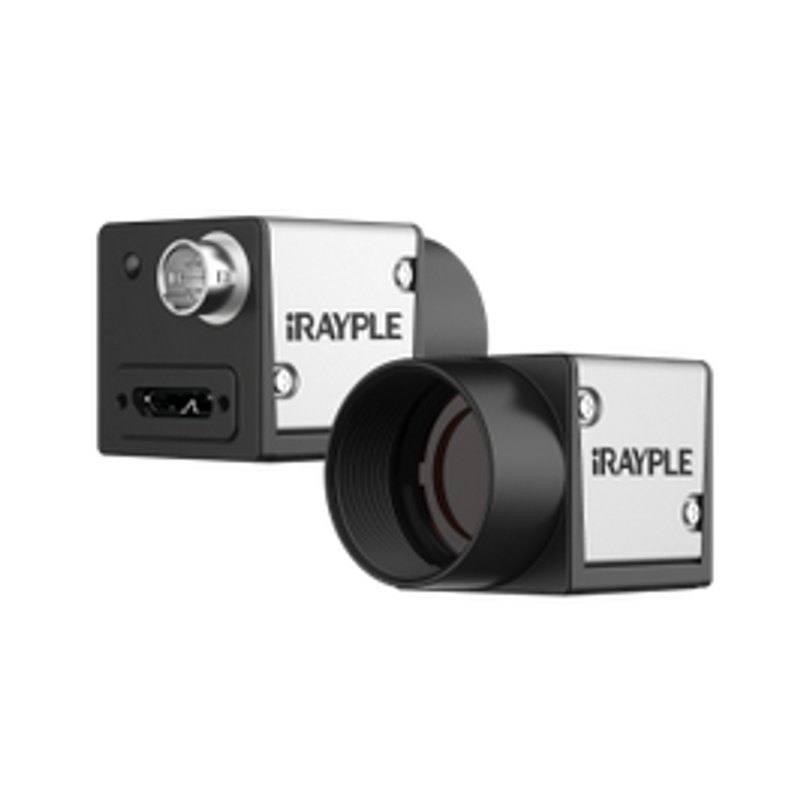
iRAYPLE A5031CU815E (640x480, 815fps, PYTHON300, USB3.0) machine vision camera
  • Rosepetal compatible
  • Recommended by AIS Vision

iRAYPLE A5031CU815E High-Speed USB3 Area Scan Camera

A5031CU815E

The A5031CU815E is part of iRAYPLE's 5000 Series and uses the OnSemi PYTHON 300 1/4" global-shutter CMOS sensor to achieve an exceptional 815 fps at full 640×480 resolution with 10-bit depth. It interfaces via USB3.0 (USB3 Vision protocol, GenICam-compliant) with 5 Gbps theoretical bandwidth and supports power delivery through the USB connector or an external Hirose DC 9–24 V supply drawing approximately 3.4 W. The camera includes a C-mount lens interface, 64 MB image buffer, opto-isolated GPIO, full ISP pipeline (sharpness, denoising, gamma/LUT, white balance, color matrix), and conforms to CE, FCC, and RoHS standards.

Brand
iRAYPLE
Camera type
Area Scan
Interface
USB 3.0
Resolution
0.3 MP
Horizontal resolution
640 × 480 px
Mono / color
Color (Bayer RG/GB)
Sensor manufacturer
onsemi (OnSemi)
Sensor model
PYTHON 300
Shutter
Global Shutter
FPS
815 fps
Mount
C-Mount
Sensor size
1/4"

Technical overview

The iRAYPLE A5031CU815E is built around the OnSemi PYTHON 300, a 1/4" global-shutter CMOS sensor that resolves 640 × 480 pixels at a 4.8 × 4.8 µm pixel pitch. Because the entire pixel array exposes simultaneously — rather than line by line — the camera captures fast-moving objects without the skew or motion artifacts that rolling-shutter designs introduce. At full VGA resolution it sustains 815 fps with 10-bit pixel depth, making it one of the fastest USB-connected cameras available at this price tier. For installers this means an approximately 1.2 ms inter-frame interval at full frame: more than adequate to freeze sub-millimeter features on high-speed conveyors, rotating shafts, or fast robotic end-effectors without requiring an exceptionally short strobe pulse.

The USB 3.0 interface operates at up to 5 Gbps theoretical bandwidth and conforms to the USB3 Vision and GenICam standards, so the camera integrates into any compliant SDK or third-party vision library without vendor-specific drivers. Power is drawn directly from the USB bus (no separate supply required in most installations), though the camera also accepts an external Hirose DC 9–24 V input at roughly 3.4 W — useful when cable runs are long or the host port is current-limited. A 64 MB on-board image buffer absorbs burst traffic between the sensor and the host, reducing frame-drop risk during OS scheduling interruptions. Opto-isolated GPIO enables hardware triggering from a PLC, encoder, or photoelectric sensor, while the full ISP pipeline — sharpness, denoising, gamma/LUT, white balance, and a color matrix — allows per-installation color calibration on the Bayer RG/GB output without post-processing overhead on the host PC.

The 29 × 29 × 29 mm cube housing weighs only 60 g, so it mounts without counterweighting on robot wrists, gantry slides, or tight panel cutouts where larger cameras cannot fit. The C-mount interface gives access to a wide range of standard lenses; on a 1/4" sensor the image circle requirement is modest, which means compact, low-cost C-mount optics cover the sensor fully. The −30 to +50 °C operating range accommodates cold-storage lines and warm semiconductor fabs alike, and CE, FCC, and RoHS certification satisfies typical factory compliance requirements for electronics and automotive customers.

Best for

  • High-speed surface and defect inspection on fast-moving web or discrete-part lines where global shutter is mandatory to avoid motion blur — the 815 fps throughput allows multiple frames per part even at aggressive conveyor speeds.
  • Robot guidance and end-of-arm inspection where the 60 g weight and 29 mm cube form factor are critical constraints and USB bus-power eliminates the need for a separate cable harness.
  • Dimensional measurement of small components in electronics or semiconductor assembly, where the 4.8 µm pixel pitch on a calibrated C-mount lens delivers repeatable sub-pixel edge detection at moderate magnifications.
  • Packaging and traceability applications that require color differentiation — label color verification, cap/closure color sorting — combined with code reading at high throughput, all in a single camera pass.
  • R&D and process characterization in pharma or battery manufacturing where 10-bit depth preserves fine gray-level gradations for quantitative image analysis and the wide −30 to +50 °C range covers environmental chamber testing.

Selection notes

  • Lens selection must cover the 1/4" image circle: confirm the chosen C-mount optic is rated for 1/4" or larger format. A lens specified only for smaller formats will vignette the corners. At 640 × 480 with 4.8 µm pixels the diagonal is approximately 3.84 mm, so any standard 1/4" C-mount lens is sufficient.
  • USB cable length is practically limited to around 3–5 m without an active repeater or hub; plan cable routing early. For runs beyond 5 m, the external Hirose DC 9–24 V power input ensures stable operation even if a powered repeater introduces slight voltage drop on the data lines.
  • The 64 MB image buffer provides a burst cushion but is not a substitute for a host PC with adequate USB 3.0 controller throughput. Avoid sharing the USB controller with other high-bandwidth peripherals (storage drives, other cameras) on the same root hub — dedicate a controller port where possible to maintain 815 fps sustained transfer.
  • Lighting and trigger integration: the opto-isolated GPIO supports hardware-triggered acquisition, which is essential at 815 fps to synchronize exposure precisely with a strobe. Continuous lighting at 815 fps requires very high luminance to achieve adequate exposure at short integration times; a pulsed LED strobe synchronized to the trigger input is typically the correct pairing.
  • The color Bayer output requires demosaicing before color analysis; this adds CPU or GPU overhead on the host. If only intensity-based inspection is needed (edge detection, dimensional checks), consider whether a monochrome variant would simplify the pipeline and improve effective SNR per pixel.

Specifications: General
BrandiRAYPLE
Camera typeArea Scan

Specifications: Sensor
Resolution0.3 MP
Horizontal resolution640 × 480 px
Mono / colorColor (Bayer RG/GB)
Sensor manufactureronsemi (OnSemi)
Sensor modelPYTHON 300
ShutterGlobal Shutter
Sensor size1/4"
Pixel size4.8 × 4.8 μm

Specifications: Performance
FPS815 fps

Specifications: Interface
InterfaceUSB 3.0
ProtocolsUSB3 Vision, GenICam

Specifications: Optics
MountC-Mount

Specifications: Electrical
PowerUSB or Hirose DC 9–24 V
Power consumption3.4 W

Specifications: Environment
Operating temperature-30 to +50 °C

Specifications: Mechanical
Dimensions29 × 29 × 29 mm
Weight60 g

Frequently asked questions

Related technical guides

Rosepetal · AI

Test this camera with Rosepetal

Validate your visual inspection with AI: send us sample images and we evaluate the case on your hardware.

AIS Vision · Integration

We validate camera + lens + lighting

AIS Vision defines and tests the optimal combination of camera, optics and lighting for your application before you buy.