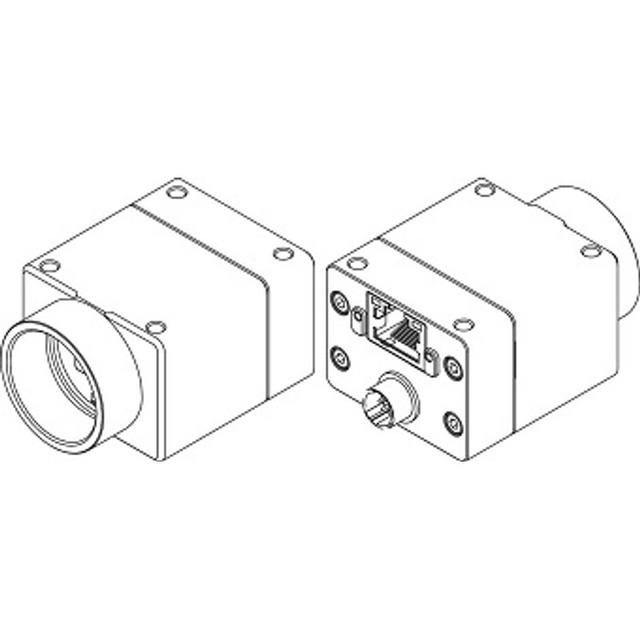
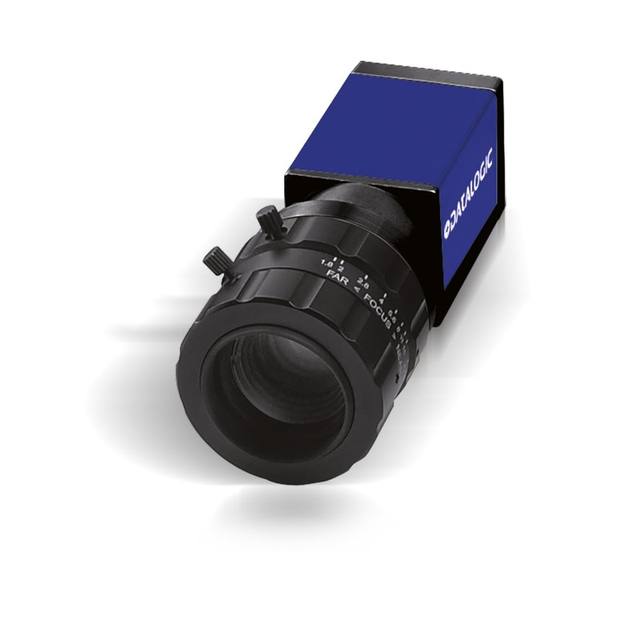
The iRAYPLE AE3600MG010E (monochrome) and AE3600CG010E (color) are GigE area scan cameras built around the Sony IMX178 1/1.8-inch CMOS sensor delivering 3072×2048 resolution at 19 fps with a 2.4 μm pixel pitch and rolling shutter. They support PoE or wide-voltage DC 9–24 V power via a 6-pin Hirose connector, comply with GigE Vision V2.0 and GenICam standards, and carry 256 MB on-board image cache. The compact 29×29×42 mm aluminum housing includes opto-isolated GPIO and a C-mount lens interface, making them suited to PCB inspection, semiconductor, pharmaceutical, and 3C electronics applications.
The iRAYPLE AE3600MG010E is a 6.3 MP GigE area scan camera built around Sony's IMX178 CMOS sensor in a 1/1.8-inch optical format. The 3072 x 2048 pixel array with 2.4 x 2.4 µm pixels delivers high spatial density without requiring an unusually large or expensive lens, since the 1/1.8-inch format is compatible with any C-mount lens that covers a 1/1.8-inch or larger image circle. At 19.2 fps full resolution the camera sustains genuinely useful throughput for inline inspection of parts moving on a conveyor or indexed through a fixture — fast enough to keep pace with most pick-and-place, packaging, and PCB-handling equipment without needing a high-speed variant. The rolling shutter captures each row sequentially, so stationary or slowly moving subjects are reproduced without distortion; for applications where parts do move during exposure the camera documents Global Reset Release support, which allows all rows to begin integration simultaneously and then read out sequentially, giving clean edges on moderately dynamic scenes when paired with a suitably short strobe pulse.
Connectivity is handled over GigE (1 Gbps Ethernet, runs to 100 m on standard Cat 5e/6 cable), with compliance to GigE Vision V2.0 and GenICam ensuring the camera integrates with any compliant SDK or frame-grabber software without vendor-locked drivers. Power-over-Ethernet simplifies cabling in multi-camera arrays — a single Cat 6 cable carries both data and the 2.5 W draw, eliminating a dedicated power run to each head. Where PoE infrastructure is unavailable the 6-pin Hirose connector accepts wide-range DC 9–24 V, covering both 12 V and 24 V industrial rails. The 256 MB onboard image cache absorbs brief bus-contention bursts that occur in multi-camera GigE installations without dropping frames. Opto-isolated GPIO provides hardware trigger input and strobe output at signal-ground isolation adequate for noisy machine environments, and the compact 29 x 29 x 42 mm aluminum body at 98 g lets it be mounted in tight enclosures or on robot end-of-arm tooling without significant mass penalty.
The C-mount interface and 1/1.8-inch sensor format are served by a wide range of off-the-shelf lenses; any C-mount lens covering a 1/1.8-inch or larger image circle is mechanically and optically compatible, spanning focal lengths suited to close-range PCB and chip inspection through mid-range packaging and pharmaceutical vial checks. Integrators specifying lighting should note the rolling-shutter architecture: continuous LED ring or dome illumination works well for static scenes, while strobed coaxial or diffuse front lighting synchronized to the GPIO strobe output is the standard approach for parts that index or travel during capture. The 0°C to +50°C operating range suits typical factory-floor and laboratory enclosures but should be evaluated carefully for foundry-adjacent or outdoor environments. The monochrome variant (MG010E) extracts maximum spatial resolution and sensitivity from the IMX178 pixel array, making it the default choice for dimensional measurement, text reading, and surface defect work; the color variant (CG010E) shares the same housing and interface and is catalogued as a paired SKU for applications where hue discrimination — label color verification, pharmaceutical capsule sorting, solder paste color contrast — adds inspection value.
Best for
PCB and SMT assembly inspection where the 3072 x 2048 resolution resolves fine-pitch component pads and solder joints across a reasonably wide field of view in a single shot, reducing the need for multi-camera tiling.
Pharmaceutical blister-pack and vial inspection requiring high pixel count to read micro-printed lot codes and detect fill-level or particulate defects at production line speeds within the 19.2 fps budget.
Semiconductor and 3C electronics traceability — reading Data Matrix and QR codes laser-marked on chips, PCBs, or metal housings where the monochrome sensor's resolution and sensitivity outperforms lower-megapixel alternatives.
Dimensional measurement of machined or molded parts in gauging fixtures where the sub-pixel-accurate pixel array combined with a telecentric or low-distortion C-mount lens resolves feature sizes to the micrometer range across a controlled working distance.
Multi-camera GigE arrays in logistics sortation or packaging lines where PoE support, the 29 x 29 mm footprint, and GigE Vision / GenICam compliance simplify integration of multiple heads onto a single managed switch without per-camera power wiring.
Selection notes
Rolling shutter requires either a stationary subject during exposure or strobe synchronization via the opto-isolated GPIO trigger/strobe lines to avoid row-skew artifacts on moving parts; confirm your conveyor speed and exposure budget before committing to this model over a global-shutter alternative.
The 1/1.8-inch sensor format is compatible with any C-mount lens that covers a 1/1.8-inch or larger image circle; lenses designed for smaller formats (e.g. 1/2-inch or 1/3-inch sensors) will not cover the full image circle and will produce corner shading that degrades defect detection near frame edges.
GigE at 1 Gbps is the sole interface; confirm your host PC NIC or managed switch supports Jumbo Frames (typically 9000-byte MTU) and that the network is dedicated or VLAN-isolated to achieve consistent 19.2 fps throughput, particularly in multi-camera installations sharing a common switch.
PoE power draw is 2.5 W, well within the 15.4 W IEEE 802.3af budget, so any standard PoE switch port is sufficient; however, confirm the 6-pin Hirose pinout if using the DC input path, as wiring errors on the GPIO lines sharing that connector can damage opto-isolated I/O.
The 0°C to +50°C operating range is adequate for most enclosed industrial environments but should be checked against worst-case ambient in foundry, outdoor, or heat-intensive soldering-line enclosures; active cooling or thermal-management planning may be required at the upper boundary.
Specifications: General
Brand
iRAYPLE
Camera type
Area Scan
Specifications: Sensor
Resolution
6.3 MP
Horizontal resolution
3072 × 2048 px
Mono / color
Mono (MG010E) / Color (CG010E)
Sensor manufacturer
Sony
Sensor model
Sony IMX178
Shutter
Rolling (Global Reset Release supported)
Sensor size
1/1.8 inch
Pixel size
2.4 × 2.4 μm
Specifications: Performance
FPS
19.2 fps
Specifications: Interface
Interface
GigE (1 Gbps, up to 100 m)
Protocols
GigE Vision V2.0, GenICam
Specifications: Optics
Mount
C-mount
Specifications: Electrical
Power
PoE / DC 9–24 V via 6-pin Hirose
Power consumption
2.5 W
Specifications: Environment
Operating temperature
0°C to +50°C
Specifications: Mechanical
Dimensions
29 × 29 × 42 mm (excluding lens mount and rear connector)
Weight
98 g
Applications this camera is commonly selected for. Open one to see the full recommended hardware and approach.
Follow these steps to bring up your iRAYPLE camera, capture a first image, and move from the viewer to your own application. The flow is the same across the A, AE, AX and L series; only the physical interface differs.
Download and install the iRAYPLE machine-vision SDK together with its viewer client for your operating system. The installer provides the camera drivers, the GenTL producer, and the viewer you will use for first light. For GigE Vision models, also install or enable the bundled filter/performance driver on the network adapter to maximize throughput.
2. Connect the camera to the correct interface
Wire the camera to its matching host interface: a dedicated Gigabit (or 10 GigE) NIC for GigE Vision models, a USB3 Vision port with a quality cable for USB3 models, or a frame grabber for CoaXPress models. Power the camera (PoE, USB bus power, or PoCXP / external supply as applicable). For GigE Vision, put the NIC and camera on the same subnet and, where supported, enable jumbo frames.
3. Detect and open the camera in the viewer
Launch the iRAYPLE viewer, run device enumeration, and select your camera from the discovered list. Open it to load the device feature tree (GenICam node map). If a GigE camera is found but cannot be opened, correct the IP configuration so the camera and NIC are in the same address range.
4. Set exposure, gain and trigger, then grab a first image
Start with continuous (free-run) acquisition under stable lighting. Adjust exposure time and gain for a well-exposed, low-noise image, set the pixel format (e.g. Mono8 or a Bayer/RGB format), and tune white balance on color models. Once the live image looks correct, switch trigger mode to hardware or software trigger to synchronize capture with your process, and verify a single triggered frame.
5. Move from the viewer to the SDK or a GenICam library
With imaging confirmed, reproduce the same settings in code using the SDK's C/C++ or Python API: enumerate, open, configure the relevant GenICam features, register a frame callback or grab loop, and convert frames to your pipeline's buffer format. Since the cameras are GenICam/GenTL-compliant, you can alternatively drive them from a third-party GenICam vision library. From here a stable image stream can feed a deep-learning inspection step such as Rosepetal for automated quality control.
Frequently asked questions
Yes. The camera provides opto-isolated GPIO that supports hardware trigger input, allowing direct connection to a PLC digital output or encoder index pulse without an external signal conditioner. The opto-isolation protects the camera from ground loops typical in machine environments. Trigger-to-exposure latency and exact wiring pinout should be confirmed in the iRAYPLE datasheet for the 6-pin Hirose connector.
GigE Vision cameras including this model strongly benefit from a dedicated Gigabit NIC or a managed switch port configured with Jumbo Frames enabled and receive-buffer size maximized. Sharing the camera's GigE link with general office traffic risks frame drops at 19.2 fps full resolution. PoE support means a single PoE-capable managed switch can power and communicate with the camera over one cable, but the port should carry camera traffic only.
Both share the same Sony IMX178 sensor, 3072 x 2048 resolution, 19.2 fps, GigE interface, C-mount, housing dimensions, and power options. The MG010E is monochrome — each pixel captures full luminance data, maximizing spatial resolution and low-light sensitivity. The CG010E uses a Bayer color filter array, yielding RGB color output at the cost of approximately half the effective luminance resolution per channel. Choose monochrome for dimensional measurement, OCR, and surface inspection; choose color where hue-based discrimination (label color, capsule color, solder paste contrast) is required.
The sensor uses a C-mount with a 1/1.8-inch optical format. The active pixel area is approximately 7.4 x 4.9 mm (3072 pixels × 2.4 µm and 2048 pixels × 2.4 µm respectively). Any C-mount lens that covers a 1/1.8-inch or larger image circle is compatible. Focal length selection depends on working distance and required field of view — shorter focal lengths (12–25 mm) suit wider inspection fields at close range, while longer focal lengths (35–50 mm) achieve tighter fields or allow greater working distance. For dimensional gauging, select a low-distortion or telecentric lens rated for 1/1.8-inch or larger coverage.
The 256 MB onboard cache stores multiple full-resolution frames (a single 3072 x 2048 monochrome frame is approximately 6 MB uncompressed, so the cache holds roughly 40 frames) to absorb short GigE bus-contention gaps in multi-camera systems. This is suitable for burst-mode triggering at moderate burst depths; for sustained high-rate multi-camera applications the cache depth and GigE bandwidth budget should be validated during system integration.